
Date
Great ideas rarely arrive fully formed. Instead, they often start as a tiny seed that gets planted when the right circumstances come together to spark something truly different.
In 2014, while Alexandre Ferrari-Roy was studying Agricultural Sciences, he had the opportunity to spend time in Barbados helping farmers integrate organic production methods. It was during this time that an idea took root: to transform unused spaces into de facto farms. Having learned in Barbados how to manage the problems that extreme heat causes for plants, he began thinking about applying that knowledge to growing plants in urban environments, which can be significantly hotter than their rural surroundings. Back in Montreal, he ran the idea by childhood friend Orlane Panet, and MicroHabitat was born in 2016.
Green roofs aren’t new, but Ferrari-Roy wanted to make urban farming more accessible. Traditional green roofs feature a layer of vegetation above a growing medium, which rests atop a waterproof membrane. While the benefits are well documented – improved building insulation, reduced stormwater runoff, carbon dioxide reduction, and biodiversity gains – the initial cost of installation can be sizeable, and the physical structure of any building must first be assessed to confirm it can bear the additional weight.
To simplify the process, MicroHabitat uses a geotextile pot system, so the plant and root system are entirely contained within the pots – making “planting” them on an otherwise unused rooftop relatively straightforward. The pair tested the model with a handful of initial clients, then began targeting hospitality and fine dining establishments in Montreal. Along the way they discovered the offer was equally appealing to large real estate companies and investment and banking funds that hold real estate assets.
It’s no secret that the real estate sector is responsible for approximately 40% of global greenhouse gas emissions, which is largely why the “E” in ESG has been under the microscope, with numerous organisations setting ambitious net zero targets. While the environmental case for urban farming is compelling in its own right, MicroHabitat also plays a significant role in the Social arena – because the output of an urban farm is the same as that of a traditional one: food.
While the farm is set up and operated by the MicroHabitat team, all produce grown is owned by the client, who chooses where it goes once harvested. Many clients make it available at a self-serve station in the office for employees to take home – a practical, tangible expression of their employer’s commitment to sustainability. Around 50% of clients donate produce to local food banks, coordinated by the MicroHabitat team. In 2025 alone, approximately 20 tonnes of produce were donated, a number that grows annually as MicroHabitat expands. In other settings – industrial, retail, healthcare, or schools with an on-site restaurant or cafeteria – harvests are delivered directly to the kitchen, often without any packaging.
It’s not just local food banks that stand to benefit. MicroHabitat partners with charities across its markets – Breakfast Club in Canada, No Kid Hungry in the US, and the Red Cross in Europe – to finance free meals for children who might otherwise go hungry. For cash-strapped institutions like schools that lack the budget to implement their own farming programme, MicroHabitat is partnering with clients such as Canon to sponsor farms in those locations.
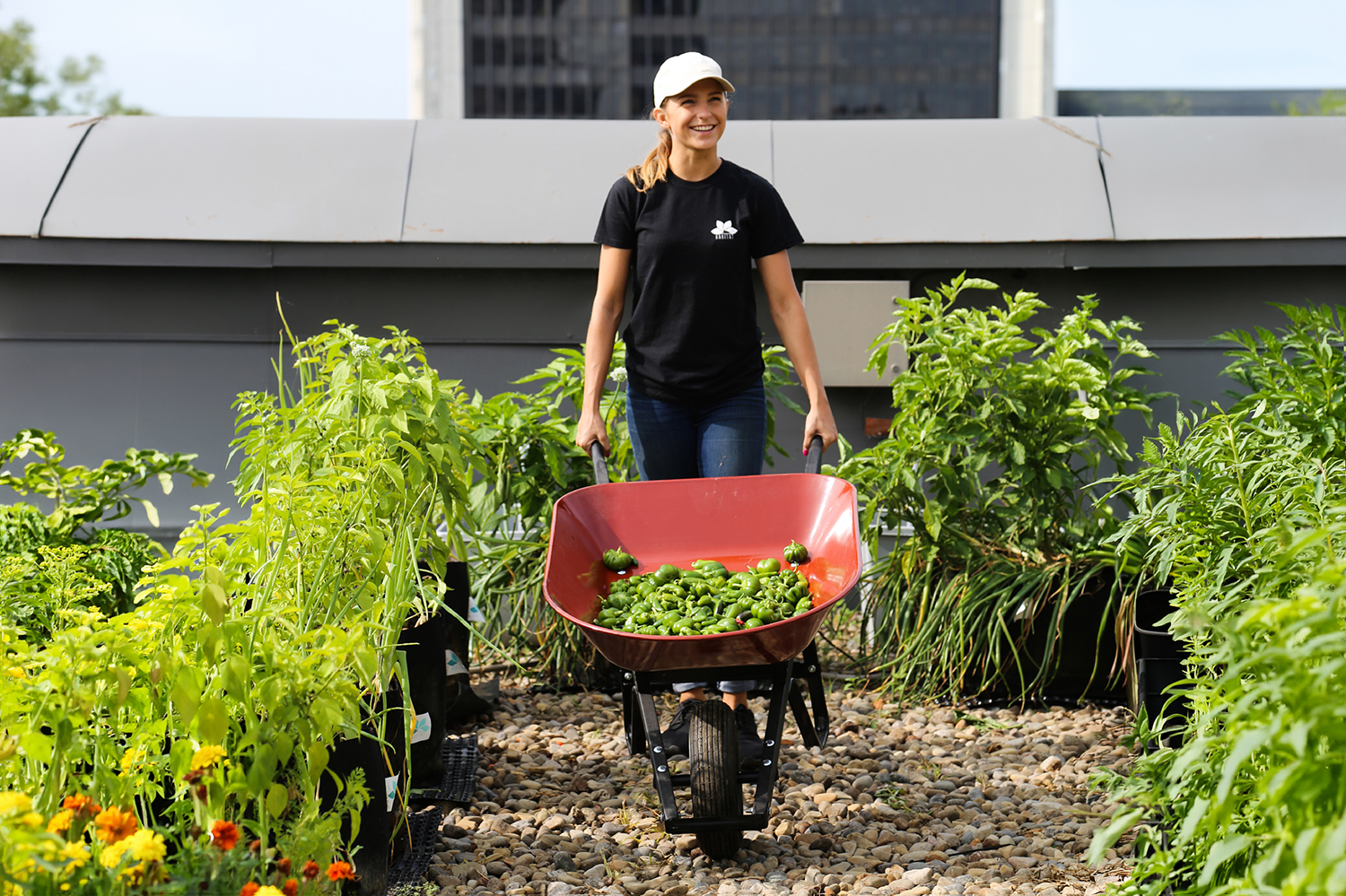
Panet (above) is clear on the broader value of this: “It’s beautiful to see how the farm is not only keeping the community together during the summer months, but how it also creates a platform for people who have arrived recently from another country and may have language barriers – they have a way of connecting through food.”
While the pandemic disrupted countless businesses, the MicroHabitat team was fortunate that food industry workers were largely exempt from COVID restrictions, allowing them to continue their work. What started with a few plant pots on Montreal rooftops gradually expanded – the team moved into Toronto in 2022 with a pilot across 13 buildings, then into New York and Vancouver. They are now present in 15 regions across North America and Europe, with plans to open four to six new regions annually, with eyes on APAC and beyond.
One of the keys to successful market expansion is finding the right local team, and things fell neatly into place when MicroHabitat began its search in Vancouver. Nicholas Gilroy was working in radio at the time, and like many people during the pandemic, had begun to consider a change. He had always had a passion for plants, and when he saw MicroHabitat’s advert for an urban farmer in Vancouver, he applied immediately. Ferrari-Roy reached out the same day, and they scheduled a call for that afternoon. Gilroy was commuting home and pressed for time, so he stopped at a small restaurant on Broadway in central Vancouver to take the call. The interview was a success, and Gilroy was hired as Vancouver’s Chief Urban Farmer in early 2022. In a full-circle moment, later that year he helped set up an urban farm on the roof of the very building on Broadway that housed the restaurant where he had his interview.
Gilroy, promoted to Director of Client and Employee Experience in January 2025, exudes an undeniable passion for his work.
“I couldn’t imagine life without growing vegetables. It’s such a fulfilling thing to do. It’s a real human thing, and I think it’s easy to be passionate about this sort of work because when you’re working with people or you’re on-site at a location, and people have their hands in the dirt, and they’re learning about vegetables, people just get so excited – and it’s something that really connects us as humans.”
The impact extends well beyond the MicroHabitat team and the building occupants. One project Gilroy worked on is a farm atop The Post building in Vancouver – an iconic mid-century decommissioned post office given a new lease of life through an ambitious heritage redevelopment. The mixed-use site, occupying an entire city block in the heart of Vancouver and home to Amazon’s local office, yielded an astonishing 1,000 pounds of produce in its first year of urban farming, all of which Amazon donated to local food banks. With plans to nearly double the size of the farm, the impact on the community is set to grow significantly. “It’s the highlight of the day to walk into a food bank with a basket full of harvest and drop that off,” Gilroy says. “Seeing people’s faces when you walk in with the harvest – that’s got to be one of my favourite things.”
The client model is straightforward. In every market MicroHabitat operates in, a local team handles the needs of clients on the ground – or on the roof. When working with a new client, satellite imaging enables the team to assess entire real estate portfolios and identify suitable spaces for urban farming, whether on a rooftop, a terrace, or at ground level. Local farmers then assess conditions and select the crops best suited to each location. Clients with accessible farm spaces can also offer volunteering time to building occupants.
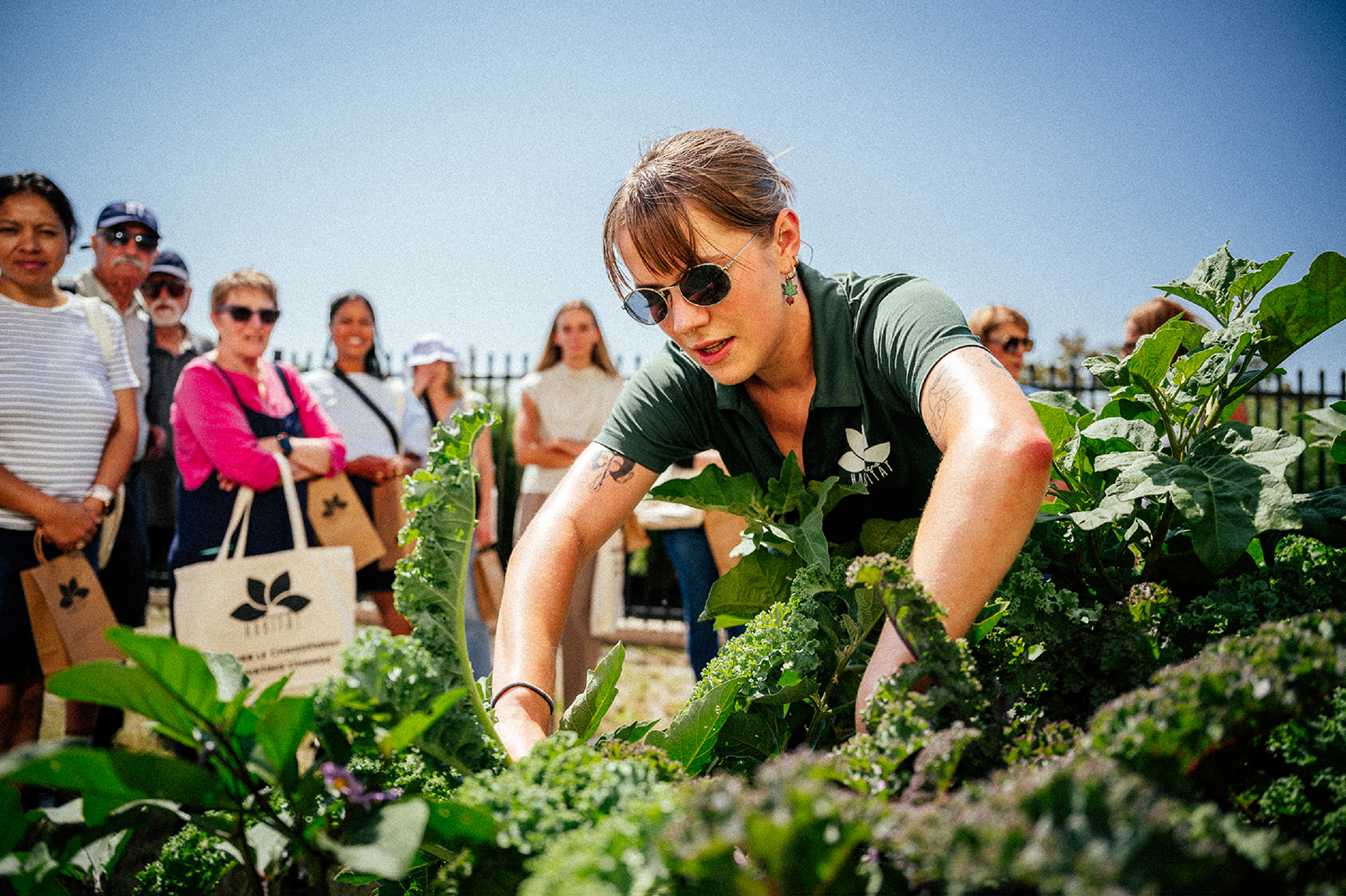
Beyond running farm operations, each local team runs a programme to connect building occupants to the farm – even if the farm itself is in a space they can’t physically access. They deliver educational workshops on home gardening, share recipes for the produce being grown, and host both virtual and in-person sessions. Clients also have access to an online platform providing real-time updates on their farm, making visible what might otherwise go unseen. The team is also building a bespoke enterprise resource planning (ERP) system for urban farming, incorporating AI to advise local teams on how to improve yields.
Urban farming isn’t as simple as taking plants that grow in one environment and potting them on a rooftop. Challenges familiar to agricultural fields – water access, pest management, and crop disease – are just as present in urban settings. Urban farmers must also contend with the urban heat island (UHI) effect, where metropolitan areas become significantly warmer than their surrounding countryside, both day and night.

The UHI effect is driven largely by human activity. Standard building materials – especially dark surfaces like asphalt and dark roofs – absorb and retain solar energy that natural landscapes would reflect or absorb differently. The vertical towers that define central business districts disrupt airflow, and traffic-choked roads sit beneath stagnant air, shielded from cooler breezes by the buildings lining the streets.
Windows – prized by office occupants for the natural light they bring – also reflect solar radiation as heat. This became vividly real in London in 2013, when reflected light from 20 Fenchurch Street, the so-called “Walkie-Talkie”, melted parts of a car parked below and was recorded at temperatures of up to 117°C at street level. Reporter Jim Waterson from City AM brought an egg and a frying pan to the hot spot and fried the egg on the pavement in the reflected glare, earning the building the nickname “Fryscraper”. Horizontal fins and glass panels were subsequently installed on the façade to diffuse the concentrated reflection.
From a climate change perspective, one of the greatest risks for urban farming is keeping farmers safe in increasingly extreme conditions. The summer of 2025 was the hottest on record in the UK, with temperatures in parts of England exceeding 33°C in both June and August. Paris saw temperatures rise above 40°C in July, temporarily closing the summit of the Eiffel Tower as a safety measure. New York City recorded 37°C in Central Park and 39°C at JFK airport. Seoul, Lisbon, and Delhi experienced similarly punishing conditions, and the problem was not simply short temperature spikes: many cities are facing relentless heatwaves with serious consequences for their populations. In Japan alone, more than 100,000 people were taken to hospital with heatstroke during the summer of 2025. Panet is clear-eyed about the challenge this poses for MicroHabitat’s urban farmers and is already looking to technology to help mitigate the risk.
Panet speaks with evident passion about the wider impact of what MicroHabitat is building:
“There is something very powerful in seeing that large corporations are now rallying behind the thought of challenging the status quo and rethinking how they impact a community – how their spaces can benefit the humans within them and in the surrounding area. We also see the power in the eye-opening that comes with rethinking unused spaces like rooftops, and building a food system that’s more localised, while bringing perspective on the importance of having natural spaces within the urban environment.”
MicroHabitat’s story resonates with us at Aéto because we’ve seen in our client work the outsized impact a seemingly small win can have. Sometimes it’s in the margins where you can make the biggest difference.